Elderberry Safety and the FDA: What Herbalists Need to Know
A few weeks ago, one of my students in the Community Herbalist Program sent me a message: "Oh my gosh, I just got notice that the FDA is coming to inspect where I make my herbal products."
I knew that feeling well. When I ran Mountain Mel's, I got inspected every single year. So I walked her through it. Breathe first. Then make sure your SOPs are dialed, your documentation is solid, and your labels are compliant with zero structure function claims.
A couple of things to know about her. She grows most of her own herbs. She documents everything from seed to final sale. She has a healthcare background and years of herbal training. She plays by all the rules, and is quite meticulous with her herbal practice and products.
What Happened When the FDA Inspected Her Small Herbal Business
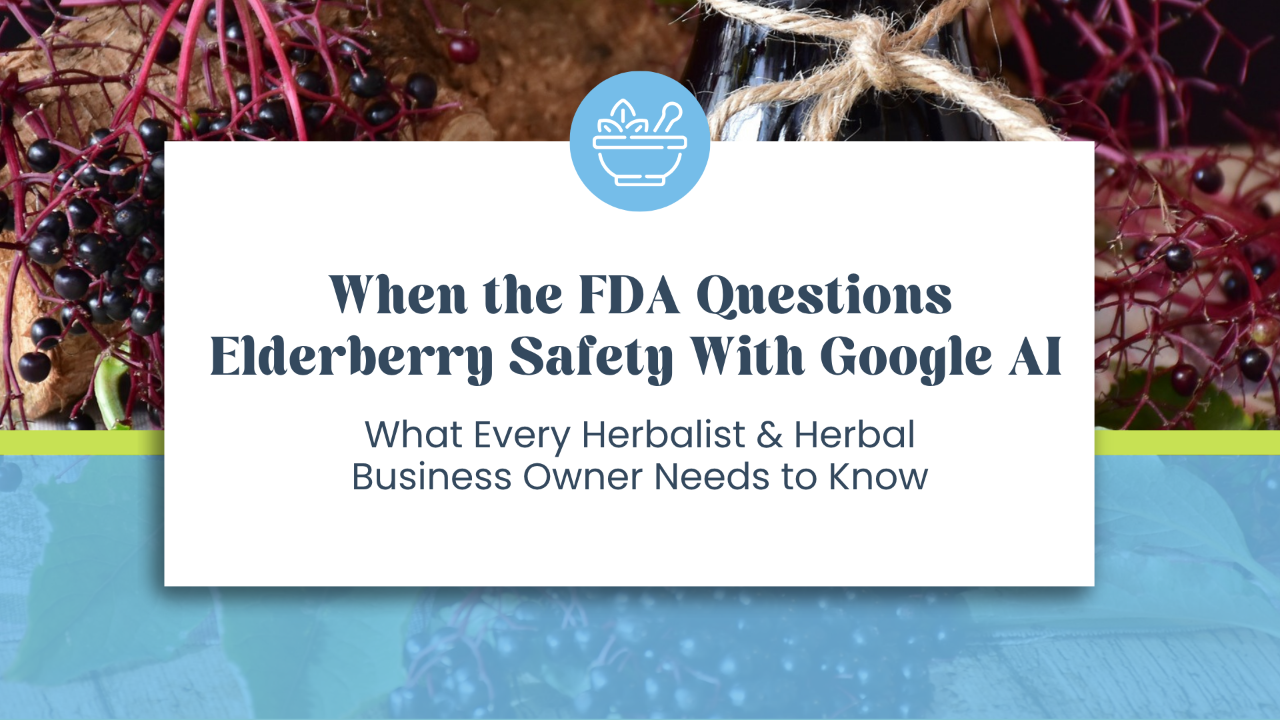
The inspection went fine. Mostly. Until the inspector got curious about elderberries.
The inspector had no problem with her elderberry syrup. But her elderberry echinacea tincture was immediately flagged as dangerous.
All thanks to his extensive research on Google AI.
Not an actual scientific study. Not a pharmacopeia. Not the American Herbal Products Association's Botanical Safety Handbook. An AI summary told him the cyanogenic glycosides in elderberries could poison people, and that was that.
Elderberry Safety and Cyanogenic Glycosides: What the Science Says
Now, cyanogenic glycosides are real. They're in the seeds, the unripe berries, the leaves, and the bark. But once elderberries are heated or properly processed, they're no longer a threat. Herbalists have known this for generations, and the research backs it up.
She explained that. She came back with stacks of studies and the Botanical Safety Handbook, which classifies elderberry in its safest category. He still wouldn't budge.
Meanwhile, Red Dye 40 is still on the shelves. But sure, let's go after the elderberry lady.
Why This Is Way Bigger Than One Tincture, and One Herbalist
When we were talking about it in our live mentorship sessions, I had a light bulb moment that came from my work on the Eclectic Herbal Wisdom podcast. I frequently get to see a library of old eclectic herbal books, vintage remedies, bottles of dandelion and calendula extract made by Eli Lilly (yes, that Eli Lilly), and what happened when pharmaceutical companies needed people to forget that plants were ever medicine.
Because that's what this is about. And I believe it's happening again, with AI as the new tool for the job.
I get into all of it in the episode, plus what she's doing now and the organizations that stepped up to help her.
If You Sell Herbal Products, Get Your Ducks in a Row
You can be inspected at any time, no matter how small you are. At minimum, have these in place:
-
Standard operating procedures (SOPs) for everything you make
-
Documentation from seed or source all the way to the final customer
-
Compliant labels with no structure function claims
-
A proper workspace with the right sinks and sanitation
And find your people. A mentor, a community, an organization like the American Herbal Products Association. When something like this happens, you don't want to face it alone.
That kind of support is exactly what we do inside the Community Herbalist Certification and Mentorship. Weekly calls, real cases, live guidance, and some amazing guest teachers each month. If you're feeling called to go deeper with your herbal skills, learn more here.
Listen to the full episode, and if you know someone running an herbal product line, share it with them. They need to hear this one.
Do You Have The Right Remedies On Hand?
Whether it’s a tummy ache, sleepless nights, or boosting immunity, The Ultimate Guide to Stocking Your Natural Medicine Cabinet has the top-quality remedies you need. Tested by a clinical herbalist—and her kid too!
Grab your guide below👇🏼
We hate SPAM. We will never sell your information, for any reason.
Hi, I'm Mel