Herbs for Cardiovascular Health: Hawthorn, Garlic, Motherwort, and More | The Herbalist's Path

Your heart works hard every single day. And so does the rest of your cardiovascular system, keeping blood moving, oxygen flowing, and your whole body running. Heart disease remains the number one cause of death globally, and in the United States alone, nearly half of all adults carry at least one major cardiovascular risk factor, whether that is high blood pressure, elevated cholesterol, blood sugar issues, or chronic stress. So in this episode we’re diving into some of our most supportive herbs for overall cardiovascular health.
It's important to mention that herbs aren't a magic fix for any of that, and we'd never tell you they are. But when used consistently alongside good food, movement, sleep, and stress support, they can be genuinely powerful allies for the heart and the whole cardiovascular system. So, let’s dig in, shall we?
Go ahead and hit play to listen to the full episode right here. Then, keep reading for more herbal goodness, and a tasty heart healthy shrub recipe.
Let's start with some herbal foundations before we get into the plants themselves.
Understanding Herbal Actions for the Cardiovascular System
Before diving into specific herbs, it helps to understand what we are actually asking herbs to do. Here are the key herbal actions to know when thinking about heart and cardiovascular support. Some actions may be relevant to other body systems as well, but the herbs we’re sharing in this episode have a specific affinity for the cardiovascular system. Here we go:
Cardiotonics - strengthen and tone the heart muscle and support the cardiovascular system for the long haul. Think hawthorn, motherwort, linden, and garlic.
Circulatory stimulants - move blood throughout the body, especially to the extremities. These are the herbs for cold hands and feet. Think ginger, garlic, cayenne, and cinnamon.
Hypotensives - help to normalize elevated blood pressure by supporting the heart, blood vessels, and nervous system. Garlic, hawthorn, motherwort, linden, and nettles all fit here.
Nervines - calm and soothe the nervous system, which makes a huge impact on cardiovascular health. As we know, chronic stress is one of the biggest drivers of heart disease.
Vasodilators - open and widen the blood vessels so blood can move through with ease rather than being forced through constricted pathways. Think garlic, cayenne, and ginkgo.
Culinary Herbs That Support the Heart
Some of the most powerful cardiovascular herbs are already in your kitchen. Not only are they super yum, they’re super good for you too!
Garlic - is a cardiovascular superstar. Research suggests it may help prevent and even slow arterial plaque buildup, reduce LDL cholesterol, raise HDL cholesterol, and support healthy blood pressure. The constituent allicin, responsible for much of garlic's medicinal action, is most active in raw garlic.
If raw garlic is too intense, try it fermented in honey, pickled, or in a freeze-dried supplement that retains the allicin. We highly recommend Eclectic Herb's freeze-dried garlic as a convenient option.
Ginger - brings warmth and circulation to the whole body, supports healthy blood pressure, and is rich in antioxidants that protect blood vessels from oxidative damage. It is especially helpful for people who run cold or experience poor circulation.
Rosemary - is a circulatory stimulant and vasodilator that strengthens capillary walls and improves overall circulation. It is a lovely daily herb, easy to add to food or steep into tea.
Cayenne - acts as both a circulatory stimulant and vasodilator, dilating the arteries and capillaries to improve blood flow and reduce blood pressure. It also supports healthy cholesterol levels. If the heat is too much, try it in a little honey or in capsule form.
More Powerful Herbs for Heart Health
Hawthorn: The Heart Herb
Hawthorn, or Crataegus spp., is one of the most beloved cardiovascular herbs in clinical herbalism for good reason. The leaf, berry, and flower can all be used, and it is generally regarded as safe for long-term use. Hawthorn strengthens and tones the heart muscle and the entire cardiovascular system. It is also a gentle nervine with a special affinity for grief and heartache. I love blending it with rose and albizia for emotional heart support.
For those dealing with heart palpitations or stress-related cardiovascular tension, hawthorn is a go-to. Or, try Eclectic Herb's HBP blend with hawthorn, parsley, and garlic for daily cardiovascular support.
One of my favorite preparations is a shrub made with hawthorn berries, blueberries, cinnamon, and hibiscus in organic apple cider vinegar. A glycerite works well too. I’ve dropped the recipe here for you, and you can download it too, just click here.
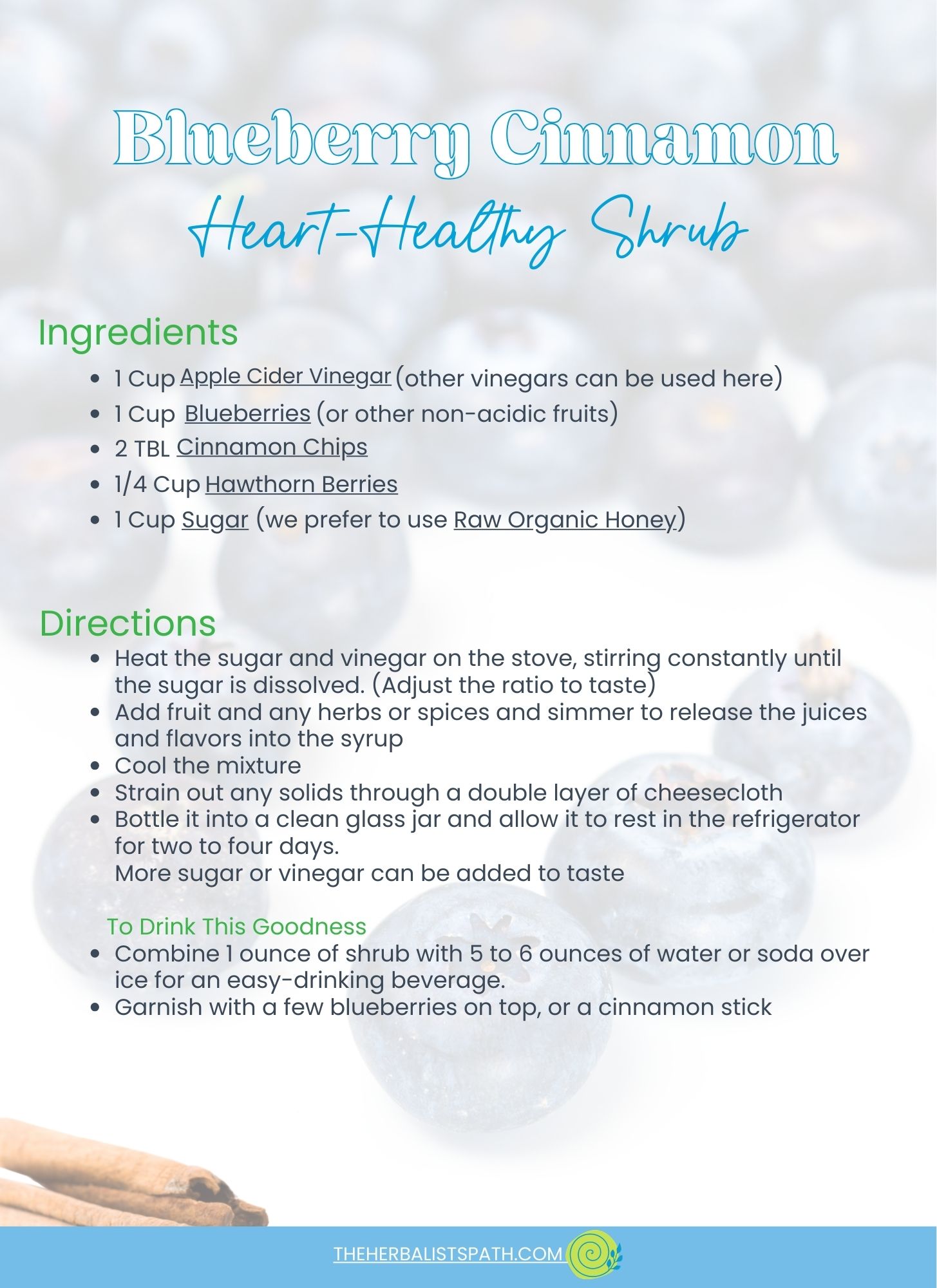
Blueberry Cinnamon Heart-Healthy Shrub
Ingredients
1 Cup Apple Cider Vinegar - (other vinegars can be used here)
1 Cup Blueberries - (or other non-acidic fruits)
2 TBL Cinnamon Chips
1/4 Cup Hawthorn Berries
1 Cup Sugar (we prefer to use Raw Organic Honey)
Directions
Heat the sugar and vinegar on the stove, stirring constantly until the sugar is dissolved. (Adjust the ratio to taste)
Add fruit and any herbs or spices and simmer to release the juices and flavors into the syrup
Cool the mixture
Strain out any solids through a double layer of cheesecloth
Bottle it into a clean glass jar and allow it to rest in the refrigerator for two to four days.
More sugar or vinegar can be added to taste
To Drink This Goodness
Combine 1 ounce of shrub with 5 to 6 ounces of water or soda over ice for an easy-drinking beverage. Garnish with a few blueberries on top, or a cinnamon stick
Motherwort for Stress and the Heart
Motherwort (Leonurus cardiaca) tells you exactly where she belongs right in the Latin name. She is a nervine and a cardiotonic with a direct affinity for the heart. She is especially helpful for stress-induced hypertension, heart palpitations, and that tight, tense feeling in the chest that comes with anxiety. I’ve found the tincture most effective for blood pressure and palpitation support. Motherwort also has a long history of supporting women through hormonal transitions and times of grief or general irritability. You know who you are…
Ginkgo and Microcirculation
Ginkgo biloba supports circulation through the smallest blood vessels in the body, the tiny capillaries delivering oxygen and nutrients to the brain, eyes, heart, and extremities. When microcirculation isn’t functioning well, you might notice brain fog, fatigue, vision changes, or persistently cold hands and feet. Ginkgo helps relax and widen blood vessels, reduces vascular resistance, and is rich in flavonoids that protect cells from oxidative stress. It is an herb I take nearly every day.
A Note on Herbs and Heart Health
Cardiovascular health is serious, and herbs are not a replacement for your medical care team. What they can be is a supportive part of a larger picture that includes nourishing food, regular movement, stress management, adequate sleep, and guidance from practitioners you trust.
If you want to learn how to think about cardiovascular herbs and so much more in a holistic way, the Community Herbalist Certification and Mentorship Program is where you can dive deeper on your herb learning journey. Check out theherbalistspath.com/community-herbalist-certification to learn more.
Resources & Further Reading
Garlic Banerjee, S.K. & Maulik, S.K. (2002). Effect of garlic on cardiovascular disorders: a review. Nutrition Journal.https://pmc.ncbi.nlm.nih.gov/articles/PMC139960/
Ried, K. (2016). Effect of garlic on serum lipids: an updated meta-analysis. Nutrition Reviews.https://pubmed.ncbi.nlm.nih.gov/23590705/
HawthornTassell, M.C. et al. (2010). Hawthorn (Crataegus spp.) in the treatment of cardiovascular disease. Pharmacognosy Reviews. https://pmc.ncbi.nlm.nih.gov/articles/PMC3249900/
Wang, J. et al. (2013). Effect of Crataegus usage in cardiovascular disease prevention: an evidence-based approach. Evidence-Based Complementary and Alternative Medicine. https://pmc.ncbi.nlm.nih.gov/articles/PMC3891531/
Ginkgo Jung, F. et al. (1990). Effect of Ginkgo biloba on fluidity of blood and peripheral microcirculation in volunteers. Arzneimittelforschung. https://pubmed.ncbi.nlm.nih.gov/2383302/
Bäurle, P. et al. (2011). A new ginkgo fresh plant extract increases microcirculation and radical scavenging activity in elderly patients. Advances in Therapy. https://pubmed.ncbi.nlm.nih.gov/22120894/
American Botanical Council American Botanical Council. Garlic Monograph. The ABC Clinical Guide to Herbs. https://www.herbalgram.org/resources/expanded-commission-e/garlic/
American Botanical Council. Hawthorn Monograph. The ABC Clinical Guide to Herbs. https://www.herbalgram.org/resources/expanded-commission-e/hawthorn/
American Botanical Council. Ginkgo Clinical Trials Database. https://www.herbalgram.org/resources/herbmedpro/herb-list/ginkgo-biloba/
Books-
Hoffmann, David. Medical Herbalism: The Science and Practice of Herbal Medicine. Healing Arts Press, 2003.
Sinadinos, Christa. The Essential Guide to Western Botanical Medicine.
Do You Have The Right Remedies On Hand?
Whether it’s a tummy ache, sleepless nights, or boosting immunity, The Ultimate Guide to Stocking Your Natural Medicine Cabinet has the top-quality remedies you need. Tested by a clinical herbalist—and her kid too!
Grab your guide below👇🏼
We hate SPAM. We will never sell your information, for any reason.
Hi, I'm Mel